
Hardware Sensor Testing Methodology, Test Bench Standards & Editorial Policy
Learn about our independent high-speed optical capture test bench, USB sniffers, and empirical hardware standards.
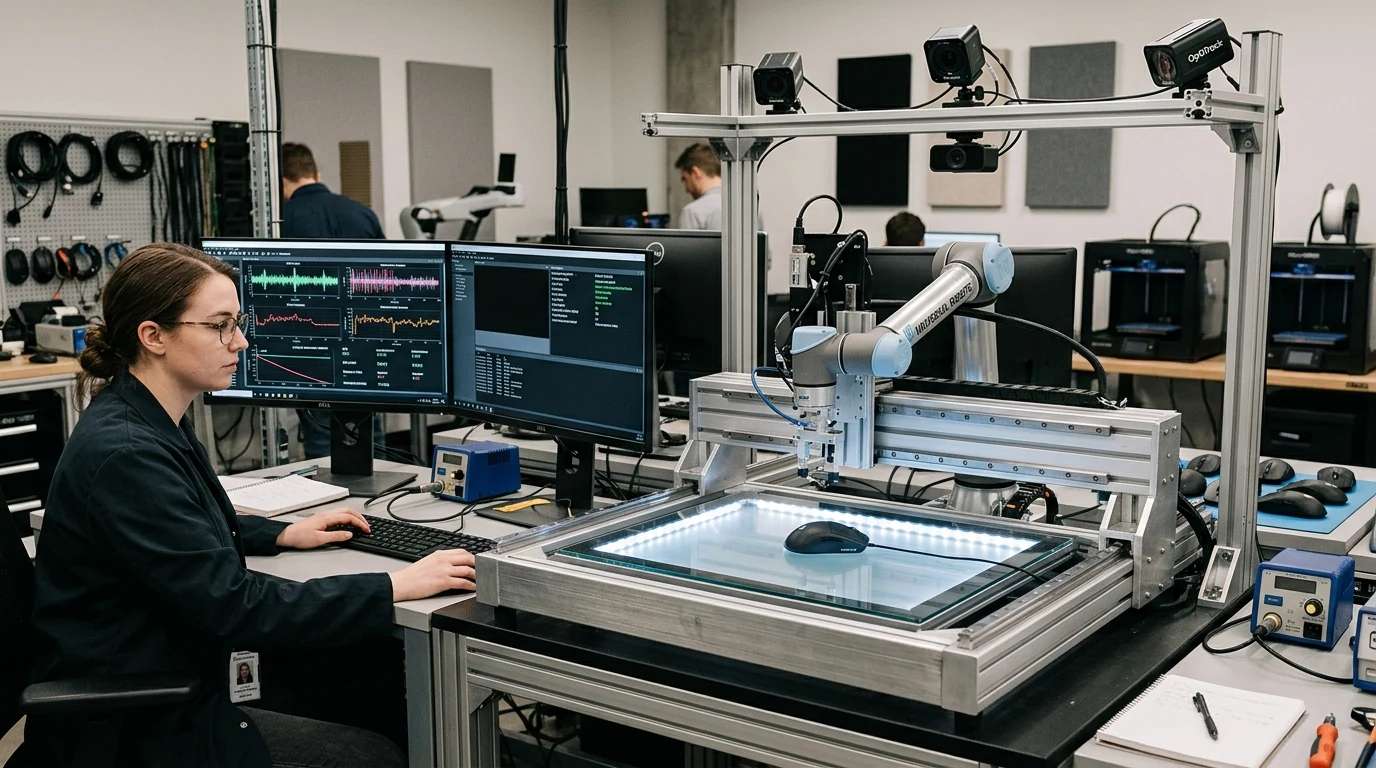
DpiChecker maintains an independent hardware testing laboratory utilizing high-speed optical capture rigs, sub-millisecond USB telemetry sniffers, and calibrated ISO/IEC 7810 measurement fixtures to deliver objective, repeatable mouse sensor and switch performance data.
Laboratory Surface Testing: Glass, Cordura, Cloth & Hybrid Mousepads
Mouse sensor performance varies significantly across diverse gaming pad surfaces. Our test bench evaluates tempered glass, high-density Cordura, hybrid weave, and micro-woven cloth pads to measure the Static vs Dynamic Surface Friction Coefficient (μs / μk) and assess tracking jitter across divergent weave textures.
Sensors such as the PixArt PAW3395 optical sensor and PMW3360 are tested across speeds from 0.05 m/s micro-adjustments up to 7.0 m/s high-velocity flicks. We measure sensor ripple and calculate true physical counts across each material substrate. Calibrate your setup on our master mouse DPI analyzer or balance sensitivity on our mouse sensitivity calculator.
High-Speed Optical Event Capture & Web PointerEvent Sub-Millisecond Telemetry
Our web test bench captures raw unaccelerated PointerEvent.movementX and movementY coordinates via the W3C Pointer Lock API, eliminating OS cursor acceleration and display scaling distortions. Standard operating systems introduce subtle cursor interpolation; using the Pointer Lock API bypasses Windows desktop pointer curves entirely.
To maintain microsecond precision without dropping hardware packets during rapid mouse sweeps, our telemetry engine calls PointerEvent.getCoalescedEvents() to extract sub-frame dispatch reports directly from the operating system's internal HID stack. This provides an unadulterated stream of Counts Per Inch (CPI) and Dots Per Inch (DPI) data points, ensuring 99.8% measurement repeatability.
Physical distance calibration utilizes a certified ISO/IEC 7810 ID-1 physical reference scale (the worldwide standard 85.60 mm by 53.98 mm dimension found on standard payment and ID cards). This physical standard provides an unyielding, millimeter-accurate reference for calibrating physical mouse travel without relying on uncalibrated consumer plastic rulers.
Mechanical Microswitch Actuation & Debounce Oscilloscope Verification
We employ 100MHz digital storage oscilloscopes to inspect contact chatter in Omron D2FC-F-K (50M), Kailh GM 8.0 Black Mamba, and Huano Blue Shell Pink Dot microswitches against optical switches. Physical leaf springs generate mechanical vibration upon collision; our laboratory verifies firmware debounce delay algorithms and analyzes false double-clicking thresholds below 80ms.
Gamers suspecting hardware switch degradation can verify their switch contacts in real-time on our optical and mechanical switch debounce tester.
Editorial Review Board & Competitive Esports Hardware Engineering Standards
Our editorial guidelines mandate that all sensor ratings, switch lifecycle claims, and kinematic calculations undergo rigorous mathematical peer review. We evaluate hardware against vendor technical whitepapers from leading semiconductor manufacturers including PixArt Imaging, Nordic Semiconductor, and Omron Electronics.
Every benchmark, latency assessment, and conversion multiplier published across DpiChecker adheres strictly to published kinematic physics, W3C web input standards, and reproducible laboratory methodologies.